
Chino Wood Flooring provides hardwood floor restoration in Chino, CA, bringing older and neglected wood floors back into use, serving surrounding cities including Eastvale, Chino Hills, Ontario, Montclair and Norco. With more than 20 years on wood floors, we can usually tell within one visit whether a tired floor needs a refinish, a restoration, or replacement.
Restoration is refinishing plus the repairs that come first. Boards that are stained through, split, loose or eaten by insects get replaced; squeaks and soft spots get fixed; gaps, nail holes and tack strip damage get filled. Only then is the floor sanded and finished as one surface.
The payoff is a floor that looks and performs like new while keeping the original wood. Solid oak that has only been sanded once or twice usually has plenty of life left, and keeping it avoids the cost and disruption of a tear-out.
Assessing an Older Wood Floor
Thickness and Past Sandings
Every full sanding removes some wood, and a floor that has been sanded many times can run thin above the tongue. We pull a floor vent or check a threshold to see how much wood remains. That tells us whether the floor can take another full sanding or needs a lighter approach.
Signs of a floor that has run thin include exposed nail heads, visible tongues at the board edges, and splintering along the seams. When a floor is near that point, we may recommend a gentler abrasion and recoat on the worst areas instead of another full cut, or replacing the thinnest boards.
Moisture and Subfloor Condition
A restoration will not last if the floor is still taking on moisture. We take moisture meter readings across the floor and check for soft spots, cupping and hollow areas. Problems below the boards get fixed before any sanding.
An old floor can carry the marks of problems that are already solved, like a long-repaired plumbing leak, and ones that are still active, like a condensate line dripping in a closet. The readings separate the two. A floor that is still wet in one area waits for the source to be fixed before we restore it.
Build Year and Paint
Many older floors meet painted baseboards, door casings and stair parts. In homes built before 1978, the EPA lead-safe rule reaches paint disturbed during the work, so we confirm the build year before sanding and contain accordingly. About 37.6 percent of Chino’s housing was built before 1980.
Repairs Before Refinishing
Replacing Damaged Boards
Boards blackened by pet urine or water, split along the grain, or damaged by termites or beetles get cut out and replaced. We weave in new boards of the same species, width and cut, staggering the joints so the repair follows the original pattern. Once sanded and finished together, the new boards blend with the old.
Where a matching board is hard to find, we can take boards from a closet or under a built-in and use new stock in that hidden spot instead. The visible repair then uses wood that has aged with the rest of the floor.
Loose Boards, Squeaks and Hollow Areas
Loose boards are refastened, squeaks are fixed by securing the subfloor to the joists, and hollow areas on glue-down floors are injected or reset. These repairs are done before sanding, since a board that moves under the sander will not finish flat.
We walk the whole floor slowly before quoting, listening and pressing with a heel along each room. Marking every loose or noisy spot with tape gives us a map, so none of them are missed once furniture is out and sanding begins.
Gaps, Holes and Tack Strip Damage
Permanent gaps are filled or corrected by replacing boards; small gaps, nail holes and tack strip holes are filled with wood filler matched to the finished color. Where there are many small defects, we trowel fill the whole floor between sanding passes. The result is a smooth, continuous surface.
Uncovering Oak Under Carpet
What We Often Find
Older homes sometimes have red oak or white oak hidden under carpet, laid when the house was built and covered later. The wood is usually in good shape in the middle of rooms and worn or stained near doors and pets’ favorite spots. We check it room by room before quoting restoration.
Carpet also hides the paint drips, drywall mud and adhesive spots left by later remodels. Most of these sand off with the old finish, but paint on a pre-1978 floor has to be handled under the lead-safe rule rather than simply sanded away, which is another reason we check the build year first.
Preparing the Floor
We pull the carpet, pad, tack strip and every staple. Pad residue is scraped and cleaned so it does not clog sanding paper. Rooms without wood under the carpet can be matched with new boards woven into the existing floor.
Matching Additions
When wood continues into a room that never had it, we lay new boards of the same species and width, tie them into the existing floor, and finish everything together. That makes a restored floor feel continuous from room to room.
Sanding and Refinishing the Restored Floor
Sanding With Care
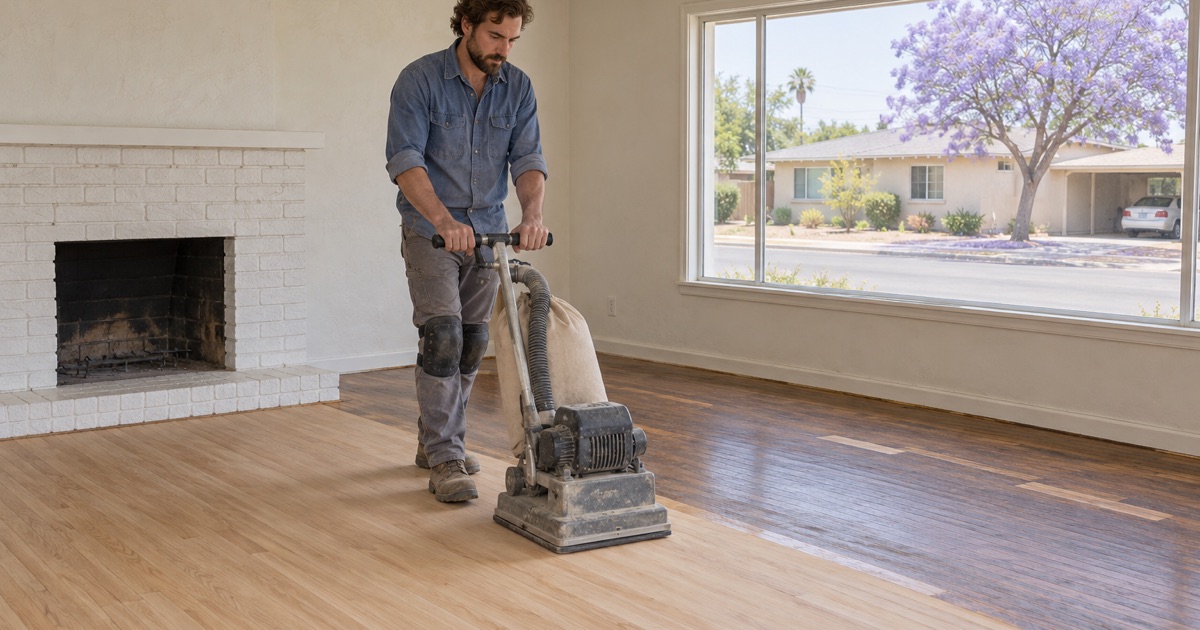
Older floors are often uneven after years of use, and a drum sander in inexperienced hands can take off too much. We sand only as deep as needed, following a grit sequence to finish smooth without wasting the remaining wood.
The edges and corners get the same care, using edgers and hand scrapers along baseboards, hearths and cabinet toe kicks. On older floors, the edges often have the most finish buildup and the least wear, so they need their own passes to match the center of the room.
Choosing a Finish
Waterborne polyurethane keeps oak closer to its natural color, oil-modified polyurethane adds warmth, and hardwax oil gives a matte, natural look. All products we use are within the South Coast AQMD Rule 1113 wood coatings limit. We show sample patches on your floor before you choose a stain.
Cure Schedule
We give you a written cure schedule showing when you can walk on the floor, when furniture can return, and when rugs can go down. Following it protects the new finish during its first weeks.
- 20+ Years of Wood Flooring
- Slab Moisture Tested First
- Free Written Estimates