
Chino Wood Flooring repairs, refinishes and installs parquet flooring in Chino, CA, drawing on more than 20 years of wood floor work and serving surrounding cities including Eastvale, Chino Hills, Ontario, Montclair and Norco. Parquet was a common choice in the 1970s and 1980s, the two decades that built more than a third of Chino’s homes, it often turns up under carpet, and it needs different handling from plank flooring at every step.
Parquet is made of small pieces of wood set in a geometric pattern and usually glued straight to the slab. That means the bond underneath, the adhesive used decades ago, and the direction of the grain all shape what can be done with it. We check each before recommending repair, refinishing or replacement.
Whether you want to save an original parquet floor or add a new pattern to a room, we give you a written plan that covers the adhesive, the slab and the finish, not only the visible surface.
Repairing Old Parquet Floors
Loose and Popping Tiles
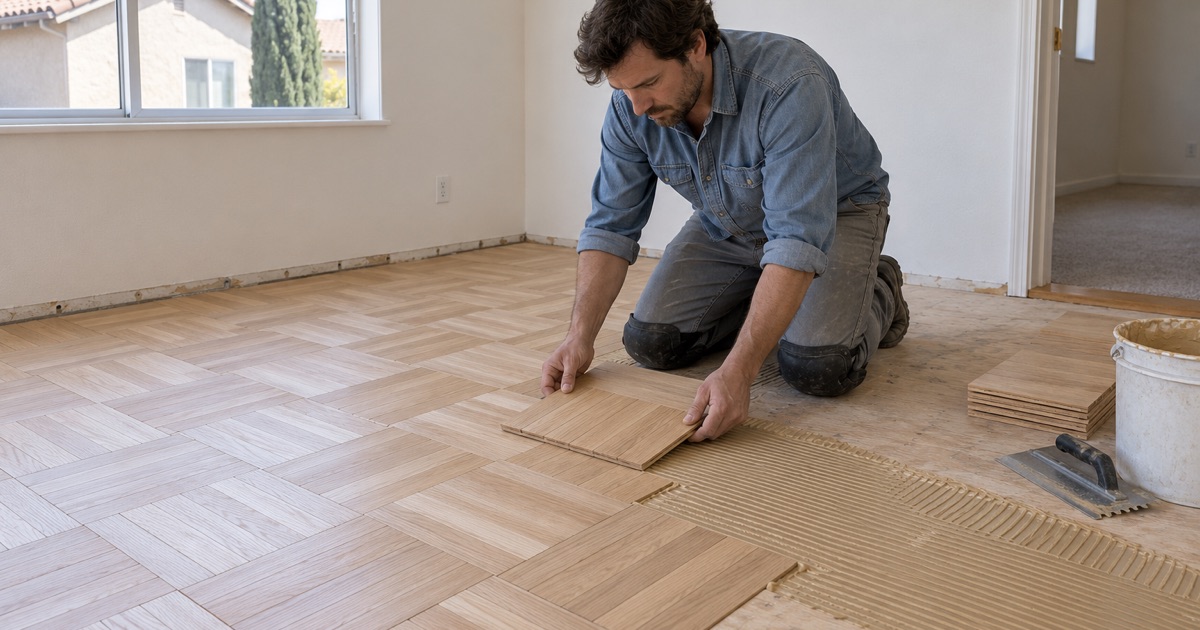
Parquet tiles lift when the adhesive under them dries out or when moisture from the slab breaks the bond. We tap across the floor to find hollow areas, lift loose tiles, clean the old adhesive, and set them back with new flooring adhesive. Where the looseness is spread across the room, we explain why a full reset may be more reliable than chasing individual tiles.
Fixing the cause matters as much as the repair. If the slab is wet, new adhesive fails the same way, so we check moisture under the loose areas first.
Missing and Damaged Pieces
Water, pets and furniture can crack or stain individual slats and blocks. We remove damaged pieces without disturbing their neighbors and fit replacements cut to the same size and grain direction. Common oak patterns can often be matched with new stock, and salvaged pieces from closets can fill gaps in rarer patterns.
Thickness matters as much as pattern. Older parquet was often made in a different thickness from what is sold today, so we measure a removed piece and plane or shim replacements to sit flush. A new block that stands proud of its neighbors catches a sander and shows as a bright square after finishing.
Gaps and Shrinkage
Parquet shrinks as it dries and can open small gaps along its pattern lines. We fill gaps with a wood filler matched to the finished color, or trowel fill the whole surface when many small gaps need attention. Large gaps usually point to past water damage, which we investigate before filling.
Parquet laid next to a sliding door or under a sunny window tends to shrink more than the rest of the floor, because the sun dries those pieces faster. When the gaps follow the light rather than a leak, filling them after the floor has settled, rather than in the middle of summer, gives a repair that stays tight.
Refinishing Parquet Floors
Sanding Wood With Grain in Every Direction
Because parquet grain runs in several directions, a drum sander leaves cross-grain scratches that show clearly under finish. We use careful drum passes at an angle to the pattern, then finish with an orbital or multi-disc sander to remove scratches from every direction. It takes longer than a plank floor, and that time is what makes the pattern look clean.
Staining Parquet
Stain highlights the grain changes between blocks, which can look striking or busy depending on the color. We lay sample patches on the sanded floor so you can see the effect before choosing. Clear finishes and light stains usually show the pattern best.
Dark stains are the hardest to get right on parquet, because every change in grain direction absorbs color differently. We sand to a finer final grit on parquet than on plank floors and may use water popping so the stain takes evenly. Where a dark color would make the pattern look patchy, we tell you before the stain goes down.
Finish Choices
We apply waterborne polyurethane, oil-modified polyurethane or hardwax oil, all within the South Coast AQMD wood coatings limit. Parquet in entries and hallways takes heavy traffic, so we explain how each finish wears and how it can be maintained with a screen and recoat later.
Removing Old Parquet and Black Mastic
Asbestos Survey Before Removal
Older parquet and tile were often laid in black mastic, and some mastics contain asbestos. South Coast AQMD Rule 1403 requires suspect materials to be surveyed before a renovation disturbs them. We identify the adhesive during our visit and arrange the survey before removal, so the schedule accounts for any notification period that follows a positive result.
Removing Parquet From a Slab
When parquet is beyond repair, we remove it, scrape or grind the old adhesive according to what the survey found, and flatten the slab. Then we test the concrete for moisture before new flooring goes down. Many homeowners replace old parquet with engineered plank or new parquet.
Removing glued parquet is slow, dusty work, and the slab underneath is rarely flat after decades of adhesive. We plan a full day or more for removal and slab preparation on most rooms, and we keep the dust contained to the work area. A properly prepared slab is what lets the next floor go down flat.
What to Install Next
After removal, the choice is open: new parquet, engineered hardwood, or a herringbone or chevron plank floor. We explain which products suit the slab and moisture reading and how each will look in your rooms.
Installing New Parquet Floors
Pattern Options
New parquet can be installed in square blocks, basket weave, herringbone, chevron or custom designs with borders. Each pattern changes how the room feels, and borders help frame a dining room or entry. We lay out patterns from the center of the room so the design is balanced at the walls.
Species and cut change the look as much as the pattern does. White oak parquet reads calm and even, red oak shows more grain and warmth, and quartersawn or rift sawn pieces give a tighter, straighter figure. We bring samples so you can see the pattern in the species you are considering.
Glue-Down on Concrete
Parquet is traditionally glued to the slab with urethane flooring adhesive. We test the slab first, prepare a flat surface, and choose an adhesive that also acts as a moisture barrier when the reading calls for it.
Pattern layout starts with chalk lines snapped from the center of the room, and the first rows are set carefully because every piece after follows them. A layout that drifts a fraction at the start becomes a visible wander by the far wall. We check squareness as we go and adjust before the error grows.
Prefinished or Site-Finished Parquet
Prefinished parquet arrives with its finish applied and is ready to use after installation. Site-finished parquet is sanded and finished in place, giving a smooth, seamless surface and your choice of stain and sheen level. We explain which suits your schedule and budget.
Site-finishing also lets new parquet match an existing plank floor in the next room, since both can take the same stain and finish on the same day. Where parquet meets plank or tile, we set a border row or a flush threshold so the change in pattern looks planned rather than cut off.
Our Step-by-Step Parquet Flooring Process
Step 1: Inspection and Adhesive Check
We tap-test the floor, check the adhesive, measure slab moisture, and confirm the build year. The findings go into a written plan before any work starts.
Step 2: Survey or Preparation
If the adhesive is suspect, we arrange the asbestos survey before any removal. Otherwise we prepare the floor for repair or installation.
Step 3: Repair or Install
We reset loose tiles, replace damaged pieces, or lay new parquet in your chosen pattern. New adhesive cures fully before sanding begins.
Step 4: Sand and Finish
We sand in several directions, apply stain if chosen, and finish the floor, then leave a written cure schedule. The schedule says when furniture and rugs can return.
- 20+ Years of Wood Flooring
- Slab Moisture Tested First
- Free Written Estimates